
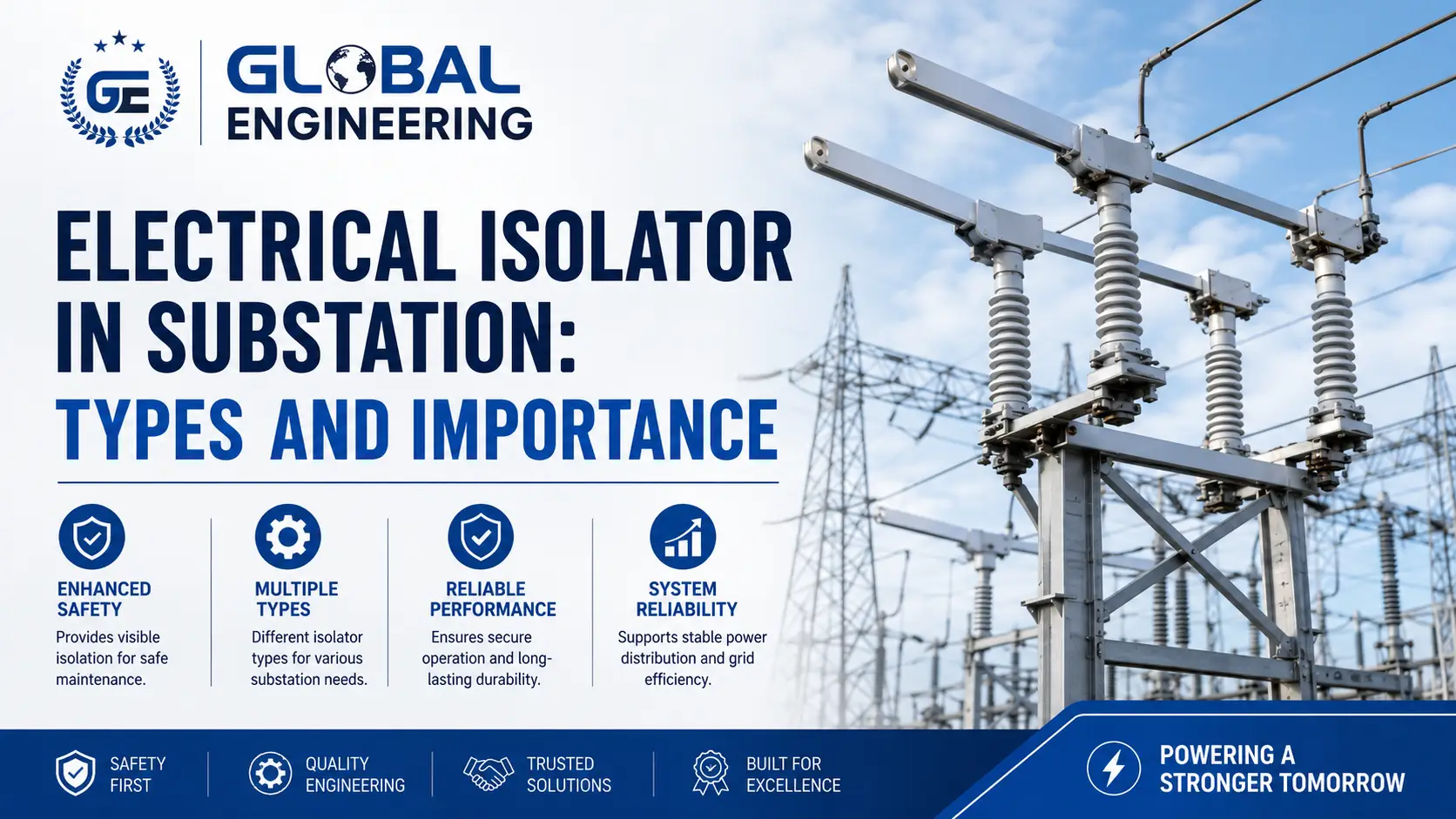
Electrical substations play a crucial role in transmitting and distributing electricity safely and efficiently. Among the various components used in a substation, the electrical isolator is one of the most important safety devices.
It is designed to disconnect electrical equipment from the power supply during maintenance or repair work, ensuring the safety of personnel and equipment. Unlike a circuit breaker, an isolator is operated only when there is no load current flowing through the circuit.
What is Isolator?
An electrical isolator is a mechanical switching device used in substations to completely isolate a section of an electrical circuit from the power source. It provides a visible open gap, allowing maintenance personnel to work safely on transformers, circuit breakers, busbars, or transmission lines without the risk of electric shock.
Since isolators are not designed to interrupt load current, they are always operated after the circuit breaker has disconnected the electrical load.
Types of Electrical Isolators Used in Substations
1. Single Break Isolator
A single break isolator has one break point in each phase and is commonly used in medium-voltage substations. It offers a simple design and reliable performance.
2. Double Break Isolator
A double break isolator provides two break points per phase, improving electrical isolation and reducing the required operating force. It is widely used in high-voltage substations.
3. Centre Break Isolator
Centre break isolators have two moving contacts that open from the center. They are commonly installed in outdoor substations due to their compact design and easy maintenance.
4. Pantograph Isolator
Pantograph isolators are mainly used in extra-high-voltage (EHV) substations where space is limited. Their vertical operating mechanism makes them suitable for compact switchyard layouts.
5. Vertical Break Isolator
Vertical break isolators move vertically when opening and are suitable for substations where horizontal space is restricted.
How Does an Electrical Isolator Work?
The operation of an electrical isolator is simple and effective. When maintenance is required, the circuit breaker first interrupts the electrical current. Once the circuit is de-energized, the isolator is opened to create a visible separation between the power source and the equipment. After maintenance is completed, the isolator is closed before the circuit breaker restores power.
Working Process:
- Circuit breaker disconnects the electrical load.
- The isolator opens to isolate the equipment.
- Maintenance or inspection is carried out safely.
- The isolator is closed after maintenance.
- The circuit breaker restores power supply.
Importance of Electrical Isolators in Substations
Electrical isolators play a vital role in ensuring the safe operation and maintenance of power systems.
Personnel Safety
They provide complete electrical isolation, protecting maintenance workers from accidental contact with live equipment.
Safe Equipment Maintenance
Isolators allow transformers, circuit breakers, and other equipment to be serviced without interrupting the entire power system.
Visible Isolation
The open contacts create a visible break, confirming that the equipment is disconnected from the power supply.
Improved System Reliability
Proper isolation reduces the risk of faults during maintenance and improves the overall reliability of the electrical network.
Compliance with Safety Standards
Electrical utilities use isolators to meet national and international electrical safety regulations.
Applications of Electrical Isolators
Electrical isolators are widely used in:
- Power Transmission Substations
- Distribution Substations
- Electrical Switchyards
- Thermal Power Plants
- Hydroelectric Power Plants
- Solar Power Plants
- Wind Energy Projects
- Industrial Power Distribution Systems
- Railway Electrification Systems
- Manufacturing Industries
Advantages of Electrical Isolators
- Provides complete electrical isolation
- Enhances operator safety
- Visible open contact position
- Reliable and durable construction
- Easy operation and maintenance
- Long service life
- Low maintenance requirements
- Suitable for high-voltage applications
- Improves system reliability
- Supports safe maintenance procedures
Maintenance Tips for Electrical Isolators
To ensure reliable performance, regular maintenance is essential.
- Inspect moving contacts for wear and damage.
- Clean insulators and contact surfaces regularly.
- Lubricate operating mechanisms as recommended.
- Tighten loose electrical connections.
- Check alignment of moving parts.
- Perform periodic functional testing.
- Replace damaged components immediately.
Conclusion
Electrical isolators are an essential part of every substation, ensuring safe isolation of electrical equipment during maintenance and inspection. They improve worker safety, enhance system reliability, and support the efficient operation of power transmission and distribution networks. Global Engineering, leading Substation structure manufacturer offers reliable, precision-engineered electrical structures and substation solutions designed to meet the highest quality standards. With a commitment to innovation, durability, and customer satisfaction, we continue to be a trusted partner for power transmission, utility, and industrial projects across India.