
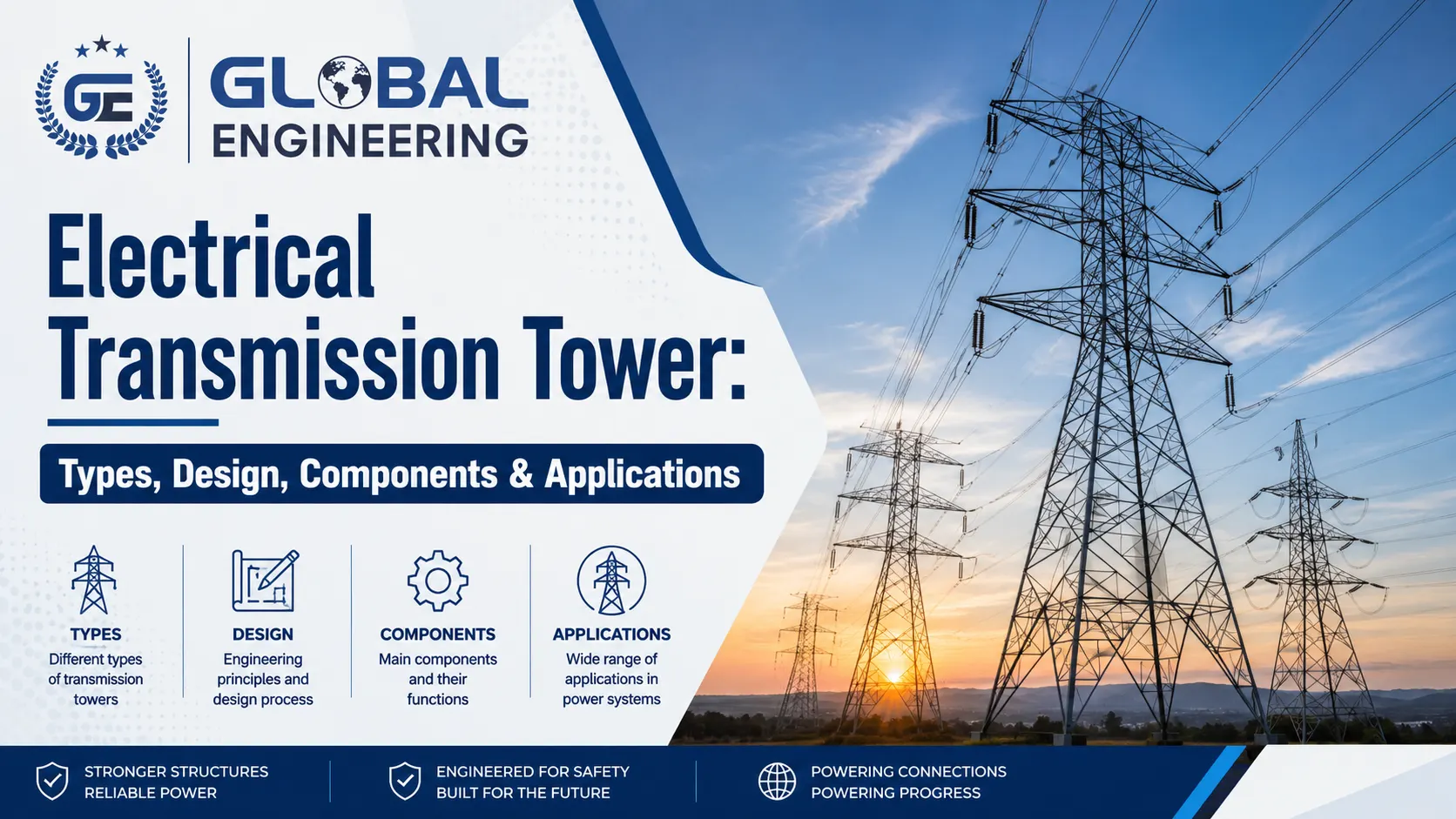
Electrical transmission towers are critical structures in power transmission networks, designed to support high-voltage overhead power lines that transport electricity from generating stations to substations and distribution centers. These towers ensure the safe and efficient transfer of electrical energy over long distances while maintaining the required clearance from the ground and surrounding structures.
As the demand for reliable electricity continues to grow, modern transmission towers have become more advanced in terms of design, strength, and durability. If you want to learn about electrical transmission towers, there is much more to discover, from their different types and structural components to their design principles and applications in power distribution networks.
What is a Transmission Tower?
An electrical transmission tower, also known as a power transmission tower or electricity pylon, is a steel framework structure used to support overhead transmission lines. These towers are designed to withstand environmental loads such as wind, rain, temperature variations, and seismic forces while carrying conductors safely across vast distances.
Transmission towers are commonly constructed from galvanized steel, which offers excellent strength and corrosion resistance, ensuring long service life even in harsh weather conditions.
Transmission Line Tower Manufacturers help create strong, durable, and precisely engineered structures that support overhead power transmission lines at the required height and spacing. Without electrical transmission towers, it would be impossible to provide a reliable and uninterrupted supply power to residential, commercial, and industrial sectors.
Main Components of an Electrical Transmission Tower
1. Tower Body
The tower body is the main structural framework of the transmission tower, designed to support the entire weight of the conductors, insulators, and other tower components. It provides the necessary strength and stability to withstand wind loads, environmental conditions, and mechanical stresses.
2. Cross Arms
Cross arms are horizontal members attached to the tower body that hold the conductors at the required spacing. They help maintain electrical clearance between power lines and ensure safe and efficient transmission of electricity.
3. Peak or Top Section
The peak is the uppermost part of the transmission tower and is typically used to support shield wires or ground wires. It plays a crucial role in protecting transmission lines from lightning strikes and electrical disturbances.
4. Insulators
Insulators are mounted on the cross arms and serve as a barrier between the energized conductors and the tower structure. They prevent leakage of electrical current and ensure the safe operation of the transmission system.
5. Conductors
Conductors are the electrical cables that carry power from generating stations to substations and distribution networks. These high-capacity wires are designed to efficiently transmit electricity over long distances with minimal energy loss.
6. Ground Wire (Shield Wire)
The ground wire is installed at the top of the transmission tower to protect conductors from lightning and atmospheric surges. It safely diverts excess electrical energy to the ground, reducing the risk of damage to the transmission system.
7. Tower Foundation
The foundation is the underground structure that supports the entire transmission tower and transfers loads to the soil. A well-designed foundation ensures stability, prevents tower settlement, and enhances the overall lifespan of the structure.
8. Bracing Members
Bracing members are steel sections connected between the main legs and body of the tower to increase structural rigidity. They help distribute loads evenly throughout the structure and improve resistance to wind and vibration.
9. Tower Legs
Tower legs are the vertical support members that connect the tower body to the foundation. They bear the primary load of the structure and provide the necessary support for maintaining tower stability.
Different Types of Transmission Towers
1. Suspension Tower
Suspension towers are used on straight transmission routes where the conductors continue in the same direction. They primarily support the weight of conductors and insulators.
2. Tension Tower
Tension towers are designed to handle additional mechanical stress and are installed where transmission lines change direction or cross obstacles.
3. Angle Tower
Angle towers are installed where the transmission line changes direction at specific angles.
Features:
- Stronger than suspension towers
- Handles lateral forces effectively
- Provides route flexibility
4. Terminal Tower
Terminal towers are placed at the beginning or end of transmission lines.
Features:
- Supports maximum conductor tension
- Ensures secure line termination
- Used near substations and power plants
5. Transposition Tower
These towers are used to interchange conductor positions to balance electrical characteristics within the transmission system.
Features:
- Improves system efficiency
- Reduces inductive interference
- Used in long-distance transmission lines
6. A Type, B Type, C Type, and D Type Towers
A Type Tower (0°–2° Deviation)
A Type towers are used on straight transmission line routes where there is little or no change in direction. These towers mainly support the vertical load of conductors and are the most economical type of transmission tower.
B Type Tower (2°–15° Deviation)
B Type towers are installed where the transmission line changes direction slightly, generally between 2° and 15°. They are designed to withstand additional side loads caused by the minor angle deviation.
C Type Tower (15°–30° Deviation)
C Type towers are used when the transmission route requires a moderate change in direction, typically between 15° and 30°. These towers have stronger structural members to handle increased tension and lateral forces.
D Type Tower (30°–60° Deviation)
D Type towers are designed for sharp line deviations ranging from 30° to 60°. They are heavily reinforced to withstand high mechanical loads and conductor tension at turning points in the transmission route.
7. Single Circuit Towers
Single circuit towers carry one set of three-phase conductors on a single tower structure. They are commonly used where power demand and transmission requirements are moderate.
8. Double Circuit Towers
Double circuit towers support two separate transmission circuits on the same structure. They help optimize land usage and increase power transmission capacity.
9. Multi-Circuit Towers
Multi-circuit towers are designed to carry more than two transmission circuits simultaneously. They are used in densely populated areas where right-of-way space is limited.
11. River Crossing Towers
River crossing towers are specially designed with greater height and strength to span wide rivers and water bodies. They provide the required conductor clearance above navigable waterways.
12. Railway Crossing Towers
Railway crossing towers are installed where transmission lines cross railway tracks. These towers ensure safe conductor clearance and compliance with railway safety regulations.
13. Road Crossing Towers
Road crossing towers support transmission lines crossing highways, roads, and expressways. They are designed to maintain adequate vertical clearance for vehicle movement and public safety.
14. Lattice Towers
Lattice towers are steel framework structures made from interconnected steel angles. They offer high strength, durability, and are the most widely used transmission tower type.
15. Tubular Towers
Tubular towers are constructed using hollow steel tubes, providing a sleek and compact design. They require less space and are often preferred in urban and residential areas.
16. Monopole Towers
Monopole towers consist of a single vertical pole structure that supports transmission lines. Their compact footprint makes them suitable for locations with limited installation space.
17. Hybrid Towers
Hybrid towers combine features of different tower designs and materials, such as steel lattice and tubular structures. They are developed to meet specific project requirements while improving performance and aesthetics.
How is a Transmission Tower Designed?
The design of a transmission tower is a complex engineering process that ensures the safe and efficient transmission of electricity over long distances. Engineers consider several factors such as voltage level, conductor weight, environmental conditions, and terrain before finalizing the tower structure.
1. Determining the Voltage Level
The first step is to identify the transmission voltage, such as 66 kV, 132 kV, 220 kV, or 400 kV. Higher voltage levels require taller towers and greater conductor clearances.
2. Route and Terrain Survey
Engineers conduct a detailed survey of the transmission line route to assess ground conditions, elevation changes, rivers, roads, railways, and other obstacles. This helps determine the appropriate tower type and spacing.
3. Load Calculation
Various loads acting on the tower are calculated, including conductor weight, insulator weight, wind pressure, ice loading (where applicable), and maintenance loads. These calculations ensure the tower can safely withstand operational and environmental stresses.
4. Structural Analysis
Advanced engineering software is used to analyze the tower structure and determine the strength required for different members. The design must remain stable under normal and extreme loading conditions.
Transmission tower is designed through careful planning, structural analysis, load calculations, and safety assessments. The final design must provide adequate strength, stability, and reliability to support power transmission lines under various operating and environmental conditions.
How Do Transmission Towers Support Power Distribution?
Transmission towers are an essential part of the electrical power system, providing the structural support needed to carry high-voltage transmission lines over long distances. They help ensure the safe, reliable, and efficient transfer of electricity from power generation stations to substations, where it is further distributed to homes, businesses, and industries.
Functions of Transmission Towers:
- Support Overhead Conductors – Hold power transmission lines securely at the required height above the ground.
- Maintain Safe Clearances – Ensure proper distance between conductors, buildings, roads, and other structures.
- Enable Long-Distance Power Transmission – Facilitate the movement of electricity from power plants to substations across vast regions.
- Withstand Mechanical and Environmental Loads – Remain stable under wind, rain, storms, and conductor tension.
- Connect the Power Grid – Link generation stations, substations, and distribution networks for continuous power flow.
- Increase Transmission Capacity – Support single, double, or multiple circuits on a single structure.
- Provide Lightning Protection – Shield wires mounted on towers help protect transmission lines from lightning strikes.
Why Choose Global Engineering for Transmission Towers?
Global Engineering is a trusted manufacturer and supplier of electrical transmission towers in India, offering robust and precision-engineered solutions for power transmission projects. The company focuses on quality manufacturing, advanced engineering practices, and compliance with industry standards to deliver reliable tower structures for various voltage levels and applications.
With a commitment to innovation, durability, and customer satisfaction, we provides transmission tower solutions that support the growing demands of modern power infrastructure projects.
FAQs About Electrical Transmission Towers
1. What is the purpose of an electrical transmission tower?
An electrical transmission tower is designed to support overhead power lines and facilitate the safe transmission of electricity from power plants to substations and distribution networks.
2. What materials are used to manufacture transmission towers?
Most transmission towers are made from high-strength galvanized steel, which provides excellent durability, corrosion resistance, and structural stability.
3. What are the 5 different types of towers?
Common types include suspension towers, tension towers, angle towers, terminal towers, single-circuit towers, double-circuit towers, and monopole towers.
4. How tall are transmission towers?
The height of transmission towers varies depending on the voltage level and application, typically ranging from 15 meters to over 100 meters for special crossings and high-voltage lines.
5. Why are transmission towers important for power distribution?
Transmission towers support high-voltage conductors, maintain safe clearances, and enable the efficient transfer of electricity over long distances, ensuring a reliable power supply to consumers.