
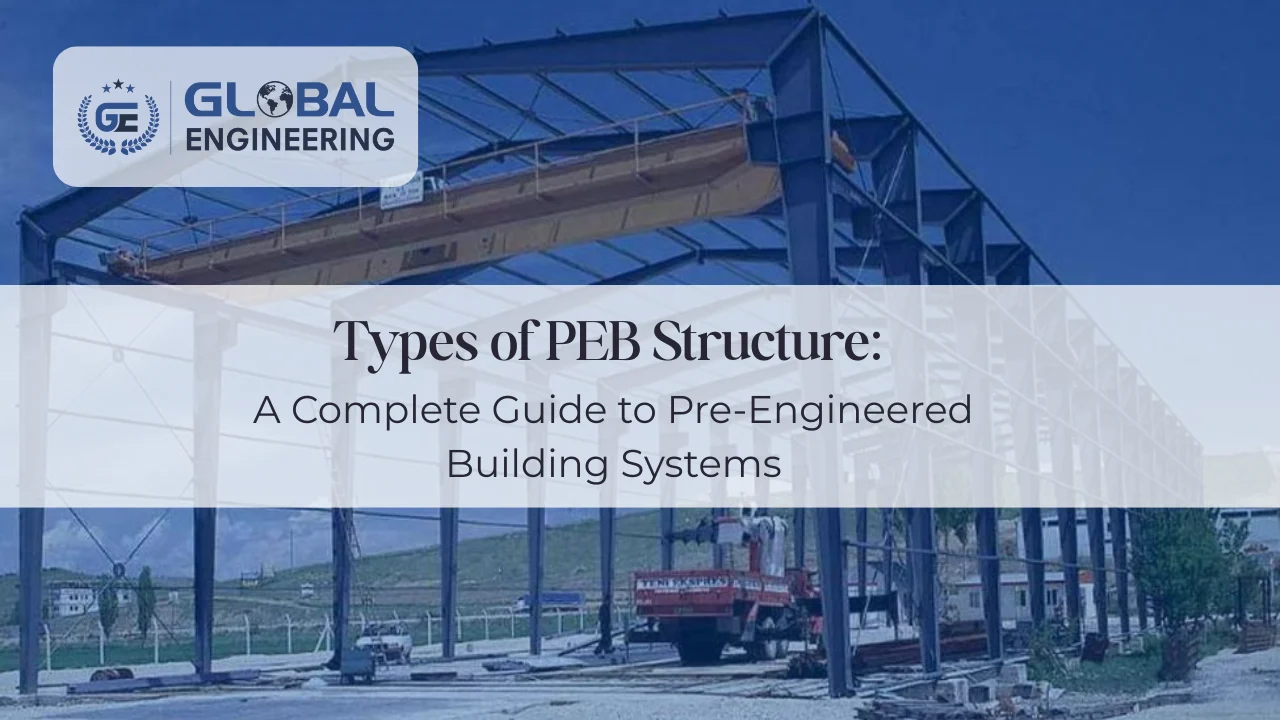
Fast-growing construction industry, Pre-Engineered Buildings (PEB) have become one of the most preferred solutions for industrial, commercial, and institutional projects. Known for their cost-effectiveness, durability, and fast installation, PEB structures offer flexibility in design and long-term performance.
At Global Engineering, we specialize in designing and manufacturing high-quality PEB structures tailored to meet modern construction requirements.
PEB Structure Meaning: Pre Engineering Building
A Pre-Engineered Building (PEB) is a steel building system that is pre-designed and fabricated in a factory before being transported to the site for assembly. These buildings are engineered using advanced software and high-grade steel components to ensure strength, stability, and precision.
PEB structures are widely used for warehouses, factories, showrooms, aircraft hangars, commercial complexes, and more.
1. Clear Span PEB Structure
A Clear Span PEB structure is designed without any internal columns between the sidewalls. This means the entire width of the building remains open and unobstructed. The load of the roof is supported by primary steel frames placed only at the edges. These structures are ideal where large uninterrupted floor space is required for smooth movement of goods, vehicles, or heavy machinery.
Clear span buildings are commonly used for warehouses, logistics centers, aircraft hangars, indoor stadiums, and exhibition halls.
2. Multi-Span PEB Structure
A Multi-Span PEB structure includes one or more interior columns between the sidewalls. These additional columns divide the total width into smaller spans, which reduces the size of rafters and primary members. This makes the structure more economical for very wide buildings.
Multi-span structures are suitable for large manufacturing plants, heavy industrial units, distribution centers, and commercial complexes. Because the load is distributed across multiple supports, the building can handle heavy roof loads, equipment loads, and even crane systems efficiently.
3. Single Slope PEB Structure
Single slope buildings are widely used for parking sheds, small industrial units, commercial shops, warehouses, and extension projects. They are cost-effective and ideal for smaller spans. The simple framing system reduces material usage and construction time, making it a practical solution for projects with budget constraints or limited space.
4. Multi-Storey PEB Structure
Multi-storey PEB structures are steel-framed buildings designed with multiple floors instead of just a single level. This type of PEB structure is increasingly used for office buildings, shopping malls, hospitals, schools, and commercial complexes. Compared to traditional RCC construction, multi-storey PEB buildings offer faster construction, reduced foundation load due to lighter weight, and better seismic performance.
5. Portal Frame PEB Structure
Portal frame PEB structures are widely used in factories, industrial sheds, workshops, and storage buildings. They provide excellent structural stability and are highly resistant to wind loads. Because of their efficient load-bearing capacity, portal frames are ideal for medium to large span buildings. Their design flexibility also allows customization based on project requirements.
6. Arch Type PEB Structure
Arch type PEB structures feature curved rafters instead of straight ones. The curved shape helps distribute loads evenly along the structure, reducing stress concentration points. These buildings are often selected for their aesthetic appearance along with structural performance.
Arch type structures are used in sports complexes, auditoriums, agricultural storage units, and exhibition halls. The curved design improves wind resistance and sometimes reduces steel consumption compared to traditional frames. They provide both functionality and architectural appeal, making them suitable for projects where design appearance matters.
7. Mezzanine Floor PEB Structure
A Mezzanine Floor PEB structure includes an intermediate floor within the main building. This additional floor is supported by steel beams and decking systems. It helps in utilizing vertical space effectively without increasing the building footprint.
Mezzanine systems are commonly used in warehouses, industrial units, and commercial storage spaces where office areas or additional storage is required. This type of structure is cost-effective and allows better space management. It is an excellent option for businesses looking to expand operational space without major structural changes.
8. Crane Supported PEB Structure
Crane-supported PEB structures are specially designed to handle overhead cranes used for lifting heavy materials. These buildings have reinforced columns, crane brackets, and heavy-duty primary members designed to withstand dynamic loads generated by crane movement.
The design requires precise load calculation to ensure safety and performance. This type of PEB structure ensures smooth material handling operations within industrial facilities.
Conclusion
PEB structures are versatile, strong, and adaptable to different industrial and commercial requirements. The selection of the right type depends on span width, load requirements, purpose of the building, budget, and future expansion plans. Each type offers unique benefits, whether it is maximum open space, structural economy, aesthetic design, or heavy load handling capability.
At Global Engineering, we design and manufacture high-quality PEB structures using advanced engineering techniques and premium-grade materials. Our focus is on durability, structural safety, timely delivery, and complete customer satisfaction. If you are planning a PEB project, contact us today for expert consultation and customized solutions tailored to your needs.